

To me, one of the best things about the marine aquarium hobby is the sheer wackiness of it all. Our oceans boast some of the weirdest creatures on the planet, and the best part of it all is that we can actually bring some of them into our home to observe. How cool is that?
In the last installment of my Wackiest Invertebrates series, we looked at some really funky shrimp. Today, let’s put their clawed cousins in the spotlight: here are some of my favorite crabs for the aquarium that will make you go “what IS that?!”. We’ll start with a variety of safe options for your home coral reef.
Weird but reef-safe crabs
Acropora/Pocillopora crab (genus Trapezia)
Talk about perfect camouflage! Trapezia is a genus of coral guard crabs, which maintain a symbiotic relationship with specific types of coral. In this case, the preferred hosts are branching Acropora and Pocillopora corals, with each crab having evolved to perfectly adapt its colors and pattern to the species that houses it.
Although they’re small (max. 2”), Trapezia crabs more than deserve the “guard” denomination. Research has found their presence makes a real difference for their host corals, which isn’t surprising—they can be quite vicious! Notably, they’re one of the few reef inhabitants who dare to face off with the venomous, invasive, coral-destroying crown-of-thorns starfish, one of the biggest current threats to coral reefs.
Coral guard crabs sometimes hitchhike their way into our tanks on—you guessed it—coral frags. Random crabs are often bad news, but don’t worry if you come across one of the polka-dotted, reddish, or purple Trapezia crabs. They can cause mild irritation in their search for tasty coral mucus to eat, especially on smaller colonies, but overall they usually contribute to their host’s health rather than damaging it.

Trapezia rufopunctata matches its host coral perfectly.
Pom-pom crab (genus Lybia)
When you think “weird crabs”, what comes to mind are probably all sorts of grotesque, freaky-looking creatures (and you would be mostly right). But just like the aforementioned Trapezia crabs, pom-pom crabs of the genus Lybia are nothing short of cute—and would you look at that stunning color and pattern combo?
Pom-pom crabs are fascinating, and a great example of kleptoparasitism in action. Those poms, which give the members of this genus a permanently cheery look, are actually pieces of anemone. The tiny (the species kept in the aquarium reach about 1”) crabs use the anemones to punch anyone who dares come too close, but they also double as handy mops to collect particles off the seafloor. The anemone doesn’t appear to benefit at all, as it’s usually just barely kept alive.
Lybia tessellata and L. edmonsoni are commonly found in the aquarium trade. They make excellent choices for nano tanks of 5 gallons and up and are considered beginner-proof. Although they might steal two small pieces of coral—such as Zoanthid polyps—to carry around on their claws in lieu of anemones, these crabs are considered reef-safe. Thanks to their stinging boxing gloves, they can hold their own when combined with normal peaceful reef species, and they also get along fine with their own kind. Squabbles do occur, but mostly involve harmless posturing.
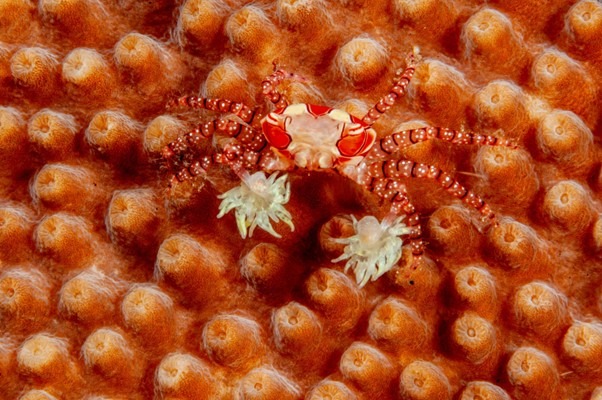
As small as they are, pom-pom crabs will not hesitate to deliver a punch if they feel threatened.
Arrow crab (Stenorhynchus seticornis)
Let’s move on from cute crabs for now and get acquainted with a rather more menacing number. The genus Stenorhynchus contains five recognized species, all similar in looks, of which one can be found in most aquarium stores. Its name is S. seticornis, the yellowline arrow crab, and it really is quite strange.
Its long, spindly legs give the arrow crab its distinctly spidery look. A significant part of the comparably tiny body, which features rusty brown and off-white striping that even runs through the eyes, is taken up by a spike protruding from the head. The bright blue claws are deceptively tiny, but don’t make the mistake of thinking this crab is defenseless. It is in fact quite feisty, and although it’s a fascinating invert to keep, you may to take some special measures to prevent it from causing mayhem if you’d like one for your tank.
Firstly, due to the species’ significant leg span, an arrow crab (singular, because they don’t get along too well with their own kind) is best kept in a tank of 30 gallons or up. Also, you should choose its tankmates carefully, because it does go after fellow invertebrates and may even try to catch slower-moving small fish. Corals can work, which is why I’ve featured this one in the reef-safe section, but I would keep my most prized possessions away from Stenorhynchus.

Orangutan Crab (Achaeus japonicus)
Aww, it’s so ugly! If you ever see tufts of orange-brown “fur” sticking out of one of your corals or anemones, a rather unusual hitchhiker may have made its way into your tank. Nothing to worry about—like the aforementioned Trapezia, orangutan crabs are coral symbionts, not parasites. They’re unfortunately difficult to find for sale in most places, but can sometimes be spotted clinging to their favorite hosts, Euphyllia and Plerogyra (bubble) corals.
Orangutan crabs aren’t known to be brawlers like some of the other coral crabs; their usefulness for their host is as a built-in cleaner. That hairy body is perfect for catching small particles as the crab moves around its coral’s polyps, ensuring nothing can get trapped and start to fester. In exchange, it receives a steady source of food, not to mention protection.
I hope orangutan crabs catch on in the hobby soon. We saltwater aquarists tend to be a little weary of these crustaceans because there are so many destructive species out there—it would be nice to have more crabs of the gentle, coral-tending kind around.

Bandit Coral Crab (Tetralia nigrolineata)
Appearances can be deceiving! Tetralia nigrolineata may look like a masked bandit, but the ecology of its genus is actually quite similar to that of Trapezia. They even prefer the same hosts: Acropora corals. In the bandit coral crab’s case, there exists a light color morph that likes Acropora tenuis and A. millepora, as well as a dark morph that can usually be found on A. gemmifera.
Like most of its kind, the bandit coral crab sometimes pops up as a hitchhiker on branching corals. They’re not all that popular yet in the hobby as a whole, and it’s somewhat rare to find them for sale, which I think is a shame! Although they can irritate particularly small coral frags, they can actually play a helpful role in keeping larger colonies healthy and thriving.
And by the way: I’ve singled out the bandit coral crab here because of its genus, it’s the most commonly seen in aquarium stores. But if you get the chance, do also look for its various brightly colored cousins, which include the orange-purple T. cinctipes and the brownish-cream T. glaberrima.

Feather star squat lobster (Allogalathea elegans)
Wait, did you just say lobster? Weren’t we talking crabs? Well, yes I did, and yes we are. The concept of squat lobsters is just another example of confusing common names, something we aquarists have to deal with all the time.
Despite the “lobster” denomination, these crustaceans—which belong to the superfamilies Galatheoidea and Chirostyloidea—are actually more closely related to hermit crabs. This makes them “cousins” of true crabs and only rather distant relatives of true lobsters. It’s easy to see how the confusion arose, though, because squat lobsters sport long front claws and an elongated body that really doesn’t scream “crab” at first glance. Evolution is strange sometimes.
Various squat lobsters can be found in the hobby, most of them somewhat drab hitchhikers. Allogalathea elegans, however, lives up to its scientific name. Its white and black striping (which varies between individuals) almost makes it look like it’s wearing a suit! These colors help it match its host in the wild: this is another symbiont. Rather than pairing up with corals, though, it lives on feather stars (Crinoids). These are unfortunately pretty much impossible to keep in the aquarium, but luckily for us, the “lobsters” seem to do fine without them.
Feather star squat lobsters are tiny and inoffensive as far as crabs go. Their body diameter rarely reaches an inch, meaning they’re suitable for nano tanks, and they’re also considered fully reef safe.

This specimen of A. elegans sports a lot of white.
Porcelain anemone crab (genus Neopetrolisthes)
Okay, I’ll admit it: like squat lobsters, which they’re closely related to, porcelain crabs (Porcellanidae) aren’t true crabs. They’re another example of carcinization, a curious evolutionary principle that demonstrates the superiority of the crab-shaped body plan. Basically, over the course of millions of years, various types of crustaceans eventually evolved to look just like crabs—even though they’re not. This is one of those. Close enough, though!
Porcelain crabs definitely fulfill the weirdness requirement, and not just in terms of appearance. The “porcelain” denomination, for example, owes to their fragility; their limbs come off surprisingly easily, but also regrow with each molt. This allows porcelain crabs like Neopetrolisthes, the most common genus in the hobby, to simply drop a leg or two and make a quick escape when attacked.
Porcelain anemone crabs are usually naturally found inhabiting anemones of the genus Stichodactyla. These are pretty hard to keep alive in the casual home aquarium, but luckily, your crabs generally won’t mind taking up residence in something a little easier—most folks go for bubble tip anemones. Just don’t think you can fool your crabs into pairing up with corals, as they absolutely refuse to host even species that look very similar to anemones.

Xenia swimming crab (genus Caphyra)
We’ve seen a fascinating range of symbioses so far. Let’s recap: Trapezia and Tetralia like branching corals such as Acropora. Orangutan crabs like bubbly corals like Plerogyra. Porcelain crabs like anemones. Feather star squat lobsters like… well, feather stars. Let’s close out the section on weird but reef-safe crabs with one last funky symbiont—one that likes one of the easiest coral species in the entire aquarium hobby.
Xenia corals are so easy to grow, and expand so rapidly, that some aquarists view them as only marginally better than underwater weeds like Aiptasia. They have a point, and I would be careful about combining Xenia with my more expensive corals. But a low-tech desktop reef completely covered with mesmerizing, pulsing polyps? That’s a yes from me, at least!
If you do choose to include Xenia coral in your marine aquarium, don’t forget to also make some space for this coral’s very best friend. Xenia swimming crabs (Caphyra loevis seems most common in the aquarium hobby) are another example of a symbiont evolving to perfectly match its host. Although their relationship is likely facultative, not obligate—neither species will die without the other—it seems to work out swimmingly. We we’ve seen, the crab keeps the coral clean, and in return receives food and shelter. It rarely leaves its host and won’t bother its tankmates, making it a fine addition to your peaceful community reef.

FOWLR-only weirdos
Decorator crab (Camposcia retusa)
If you don’t like spiders, this decorator crab probably isn’t your thing: Camposcia retusa is by far the most spidery specimen on this list, even more so than the arrow crab. But that’s not actually the weirdest thing about it—not by a long shot.
C. retusa is also known as the decorator or velcro crab thanks to its unusual method of self-protection. And indeed, it does look like a strip of velcro that was left outside in the elements and got covered in dust and other bits over time—its body even has tiny, hooked protrusions (setae) that various items stick to. But decorator crabs don’t get covered in detritus by accident: they attach it on purpose, most likely to help them blend in with their surroundings.
Decorating is a fascinating crab behavior, and seeing Camposcia at it is endlessly fun. Of course, though, despite their small size (leg span no more than about 4”), these crabs aren’t reef safe. They’ll tear at everything in their search for “clothes” to wear, which is not ideal if your tank contains expensive corals. I recommend decorator crabs for FOWLR tanks or, even better, low-tech, “dump reef”-type set-ups. Just regularly toss in bits and bobs like macroalgae, sponges, and cheap coral frags to see your crab in action.
Did you know? C. retusa isn’t the only decorator crab out there. You may have seen photos of a species called Cyclocoeloma tuberculata, which in my opinion looks even more interesting—less like a dust-covered spider and more like a real crab wearing a Zoanthid as a hat. Unfortunately, C. tuberculata isn’t available for sale anywhere that I know of, even though I’m willing to bet plenty of aquarists would be happy to set up a single-species tank and donate the occasional coral polyp for this crustacean fashionista to wear. I know I am, but then I do love a good oddball.

Teddy Bear Crab (Polydectus cupulifer)
Did you know that the pom-pom crab, previously mentioned in the section on reef-safe crabs, aren’t the only crustaceans to have figured out the power of the anemone? The highly appropriately named teddy bear crab, which belongs to the same subfamily, also wields stinging gloves. Add to this the fact that it’s entirely covered in what looks like dense, sand-colored “fur”, and I think this one more than deserves its place on this list.
The teddy bear crab is a member of the crab family Xanthidae. Although there are exceptions (such as the pom-pom crab), xanthid crabs are generally shunned by aquarists. Some of the most destructive and widely feared species, including the widely hated gorilla crab—a fish-eating, coral-destroying hitchhiker—belong to this family.
So should you avoid the teddy bear crab as well? Well, as always, that depends on you. I’d definitely keep this one far away from my prized corals, but would personally not mind setting up a small “trash tank” with some anemones for it to wear. The species’ crabtivatingly curious appearance makes it more than worth it in my opinion!
Tip: Several other hairy crab species exist. Common hitchhikers include Pilumnus vespertilio, often rather uncreatively referred to just as “hairy crab”, and the blue-eyed coral crabs of the genus Cymo. The true teddy bear crab is the biggest and baddest of these, and also the only one to wield anemones. It can also be told apart by the others from its finer, less bristly fur.

AI-generated monstrosity, or just a teddy bear crab? I’ll let you decide.
Sources & further reading
Brooker, R. M., Muñoz Ruiz, E. C., Sih, T. L., & Dixson, D. L. (2018). Shelter availability mediates decorating in the majoid crab, Camposcia retusa. Behavioral Ecology, 29(1), 179-185.
Castro, P. (2015). Symbiotic brachyura. In Treatise on Zoology-Anatomy, Taxonomy, Biology. The Crustacea, Volume 9 Part C (2 vols) (pp. 543-581). Brill.
Pratchett, M. S. (2001). Influence of coral symbionts on feeding preferences of crown-of-thorns starfish Acanthaster planci in the western Pacific. Marine Ecology Progress Series, 214, 111-119.
Sin, T. (1999). Distribution and host specialization in Tetralia crabs (Crustacea: Brachyura) symbiotic with corals in the Great Barrier Reef, Australia. Bulletin of marine science, 65(3), 839-850.
0 Comments